BepiColombo Mercury Arrival: What the Date Means
BepiColombo Mercury Arrival: What the Date Means
A Major Mercury Milestone—But the Date Must Be Verified
The European-Japanese BepiColombo mission is designed to become only the third spacecraft mission to study Mercury and the first to place two dedicated orbiters around the planet. However, a claim that BepiColombo “arrives in orbit around Mercury today” requires careful qualification.
BepiColombo launched on October 20, 2018, and has spent years using solar-electric propulsion and planetary gravity assists to reach the innermost planet. According to the European Space Agency (ESA), the mission’s schedule changed during the cruise phase. ESA currently lists Mercury orbit insertion for November 2026, followed by spacecraft separation and commissioning. Readers should check the latest ESA mission information and Japan Aerospace Exploration Agency (JAXA) updates before treating any “today” headline as confirmed.
The distinction matters. A Mercury flyby is not the same as entering orbit. A spacecraft can pass the planet, collect data, and continue along its trajectory. Orbit insertion requires a carefully timed propulsion maneuver that places the spacecraft into a stable path around Mercury.
Reaching Mercury is difficult because the planet lies deep inside the Sun’s gravitational well. A spacecraft launched from Earth already has substantial orbital speed around the Sun. Traveling inward requires it to lose much of that energy, not simply point toward the Sun. The mission must also withstand intense sunlight, high temperatures, radiation, and demanding communications conditions.
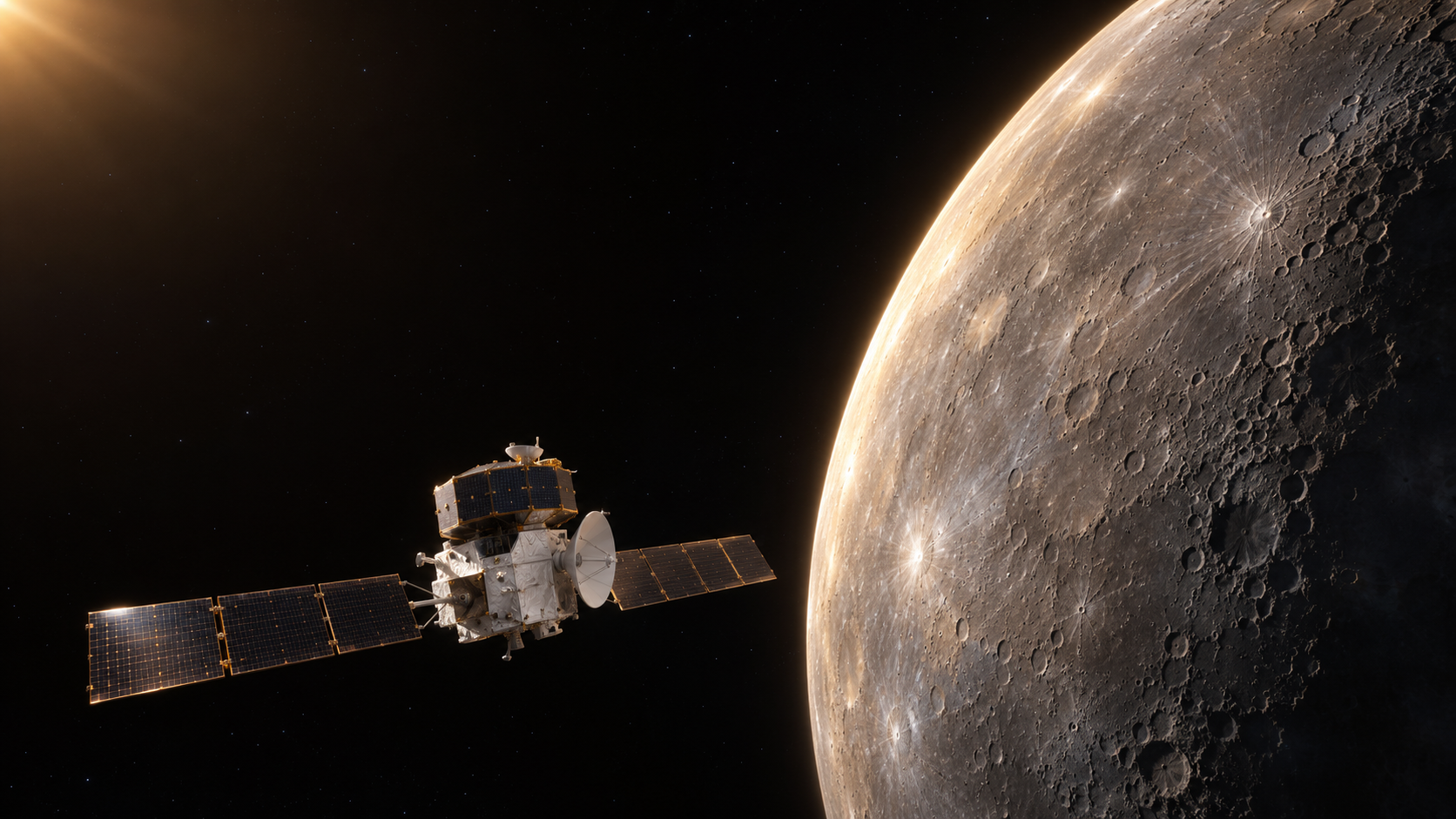
BepiColombo is a joint mission led by ESA and JAXA. It carries ESA’s Mercury Planetary Orbiter (MPO) and JAXA’s Mercury Magnetospheric Orbiter, officially named Mio. Together, the spacecraft will investigate Mercury’s surface, interior, magnetic field, magnetosphere, exosphere, and polar regions.
What Is the BepiColombo Mission?
A Joint European-Japanese Exploration Project
BepiColombo is named after Giuseppe “Bepi” Colombo, the Italian mathematician and engineer whose work helped explain how spacecraft could use planetary gravity assists to reach Mercury. ESA explains the mission’s name.
The mission uses two scientific orbiters because Mercury presents several connected but distinct scientific problems.
ESA’s Mercury Planetary Orbiter will focus primarily on the planet itself. Its instruments will study the surface, composition, topography, interior, and magnetic environment.
JAXA’s Mercury Magnetospheric Orbiter, renamed Mio, will study Mercury’s magnetic field and surrounding plasma environment. Its instruments will examine how the solar wind interacts with the planet and how particles move through its magnetosphere. JAXA provides mission information.
Operating separate orbiters allows the mission to make coordinated measurements from different locations. One spacecraft can observe the planet’s surface while the other measures particles and fields around it. This combination should provide a more complete picture than a single spacecraft could achieve.
The Spacecraft’s Main Components
During the cruise to Mercury, the two orbiters travel together in a spacecraft stack supported by the Mercury Transfer Module (MTM). The transfer module supplies solar-electric propulsion and guides the mission through the inner Solar System.
Before the operational phase at Mercury, the spacecraft are intended to separate. The MPO and Mio will then enter their respective orbits and begin independent scientific operations. The exact sequence depends on the official mission plan and spacecraft condition.
Sunward direction
       ↓

[Mercury Transfer Module]
  Solar-electric propulsion
       │
[ESA Mercury Planetary Orbiter]
  Surface, interior, and environment studies
       │
[JAXA Mio Orbiter]
  Magnetic field and magnetosphere studies
ESA and JAXA updates remain the authoritative sources for schedule changes.
Why Getting to Mercury Is So Difficult
Mercury’s Proximity to the Sun
Mercury orbits the Sun at an average distance of about 58 million kilometers. It completes one orbit in approximately 88 Earth days and moves rapidly along its path.
A spacecraft leaving Earth begins with Earth’s orbital motion around the Sun. To reach Mercury, it must reduce its solar orbital energy. Otherwise, it will cross the inner Solar System at too great a speed to be captured efficiently by Mercury’s weak gravity.
BepiColombo therefore follows a long, carefully planned trajectory. It uses solar-electric propulsion and repeated gravity assists to adjust its orbit gradually. A gravity assist changes a spacecraft’s trajectory and heliocentric speed by exchanging a small amount of momentum with a moving planet.
The spacecraft launched on an Ariane 5 rocket from Europe’s Spaceport in French Guiana on October 20, 2018. Its route includes an Earth flyby, two Venus flybys, and six Mercury flybys before the planned final arrival. ESA’s factsheet provides mission details.
The Mercury flybys progressively reduce the spacecraft’s orbit and align it with Mercury. The transfer module’s ion propulsion system provides continuous, low-thrust acceleration between planetary encounters.
Heat, Radiation, and Communications Challenges
Mercury receives roughly 6.5 times more sunlight than Earth. BepiColombo uses thermal protection, reflective surfaces, carefully selected orientations, and operational limits to control its temperature.
Solar radiation affects electronics, sensors, and communications systems. Mission controllers must plan activities around the spacecraft’s changing distance from the Sun and its position relative to Mercury and Earth.
Commands and scientific data also take time to travel between Earth and Mercury. The mission cannot rely on continuous real-time control. BepiColombo therefore requires onboard autonomy, detailed command sequences, fault protection, and extensive testing before critical operations.
The Mission Timeline
The confirmed route includes:
- Launch: October 20, 2018.
- Earth flyby: April 2020.
- First Venus flyby: October 2020.
- Second Venus flyby: August 2021.
- Six Mercury flybys: October 2021 through January 2025.
- Planned Mercury orbit insertion: November 2026, according to ESA’s published schedule.
The flybys are not merely practice encounters. Each one changes BepiColombo’s speed and direction around the Sun. The Mercury encounters also provide opportunities to test instruments and collect observations before the spacecraft reaches its final configuration.
What “Arriving in Orbit” Means
Orbit Insertion Is Not the Same as a Flyby
A flyby occurs when a spacecraft passes near a planet and continues on a departure trajectory. It may collect valuable measurements, but it is not gravitationally bound to the planet.
Orbit insertion is a propulsion maneuver designed to reduce a spacecraft’s relative speed enough for the planet’s gravity to capture it into orbit. At Mercury, this operation is particularly demanding because the planet’s gravity is weak and the spacecraft approaches after a long sequence of solar-orbit adjustments.
A headline about BepiColombo “arriving at Mercury” could refer to:
- A scheduled or completed flyby.
- A propulsion maneuver near Mercury.
- Orbit insertion.
- Separation of the MPO and Mio spacecraft.
- Deployment of antennas, booms, or other equipment.
- The beginning of commissioning.
- The start of routine scientific operations.
These events are not interchangeable. If a report claims that BepiColombo arrived “today,” check the date, time zone, event type, and official confirmation against ESA and JAXA mission updates.
The Sequence After Arrival
Orbit insertion will not immediately produce the mission’s full scientific output. The spacecraft must first complete commissioning, including:
- Confirming spacecraft health and power-system performance.
- Refining the orbit and verifying navigation.
- Separating the scientific orbiters from the transfer module.
- Deploying required antennas, booms, and instrument systems.
- Activating instruments in a controlled sequence.
- Calibrating measurements against known reference conditions.
- Testing communications and data transmission.
- Beginning routine scientific observations.
Initial images and measurements may be technically important but limited in scope. Scientific teams must calibrate the data, remove instrument effects, compare observations from both orbiters, and test interpretations before announcing major conclusions.
What BepiColombo Will Study
Mercury’s Surface and Geological History
BepiColombo will map Mercury’s surface in greater detail and measure its mineral composition, topography, and geological structures. Scientists want to understand how Mercury formed and why it developed such a large metallic core relative to its rocky exterior.
High-resolution imaging will help researchers study craters, scarps, volcanic plains, hollows, and other landforms. Spectrometers will examine surface minerals and chemical elements, while topographic measurements will reveal elevations, basin structures, and geological relationships.
These observations will extend the work of NASA’s MESSENGER mission, which orbited Mercury from 2011 to 2015. BepiColombo is designed to improve coverage, add new measurement capabilities, and observe the planet from complementary orbital positions. NASA provides information about MESSENGER.
Mercury’s Interior and Magnetic Field
Mercury has a disproportionately large iron-rich core. Understanding that core is central to explaining the planet’s origin and evolution.
BepiColombo will investigate Mercury’s interior through gravity measurements, radio tracking, topography, and magnetic-field observations. Small variations in the spacecraft’s motion can reveal differences in the planet’s internal mass distribution.
Mercury’s global magnetic field is weaker than Earth’s field but strong enough to create a magnetosphere that interacts with the solar wind. The magnetic field is generated inside the planet; the magnetosphere is the surrounding region shaped by the interaction between that field and charged particles flowing from the Sun.
The Magnetosphere and Solar Wind
The solar wind is a continuous flow of charged particles from the Sun. At Mercury, it strikes the planet’s magnetic environment with greater intensity than at Earth.
Mio’s instruments will study magnetic fields, plasma, energetic particles, and waves around Mercury. Scientists will examine processes such as magnetic reconnection, in which magnetic-field lines break and reconnect while releasing energy.
The mission will also investigate how solar activity changes Mercury’s magnetosphere. Bursts of solar particles and changing magnetic conditions can alter particle populations and produce temporary disturbances.
Mercury’s Thin Exosphere
Mercury has an extremely thin exosphere, a sparse collection of atoms and molecules that collide only rarely. Exospheric material can come from the surface through solar radiation, micrometeoroid impacts, solar-wind particles, temperature changes, radioactive decay, and other internal processes.
The exosphere changes with Mercury’s position, local time, surface composition, solar activity, and impact environment. BepiColombo will measure its composition and distribution to determine how the surface and space environment exchange material.
Because the exosphere is so thin, it behaves differently from an ordinary atmosphere. It cannot distribute heat globally in the same way Earth’s atmosphere does and remains closely linked to surface processes.
Water Ice and Permanently Shadowed Craters
Some polar craters on Mercury have floors that never receive direct sunlight. Despite the planet’s hot daytime surface, these permanently shadowed regions can remain extremely cold.
Earlier observations, particularly from MESSENGER, provided evidence for water ice and other volatile materials in polar shadowed regions. BepiColombo is not credited with making those earlier discoveries. Its role is to improve mapping, composition measurements, and the geological context surrounding these deposits.
The mission may help determine how volatile material arrived, how it is preserved, and how Mercury’s surface environment changes it. These questions also matter for the Moon and other airless bodies with permanently shadowed regions.
Why This Mission Matters
Mercury is an extreme example of a rocky planet. It has a large metallic core, a relatively thin silicate mantle, a global magnetic field, intense solar exposure, and a very thin exosphere.
Studying Mercury can test theories about how terrestrial planets form and differentiate. It may also help scientists interpret rocky exoplanets orbiting close to their stars. Mercury is not a direct model for every exoplanet, but it offers a nearby example of how a small rocky world evolves under severe stellar heating.
BepiColombo continues the work of NASA’s Mariner 10, which conducted the first Mercury flybys in the 1970s, and MESSENGER, which became the first spacecraft to orbit Mercury. Those missions answered major questions but also revealed new ones about Mercury’s interior, magnetic field, polar deposits, exosphere, and interaction with the solar wind.
The mission also demonstrates international cooperation. ESA’s MPO is optimized for observations of Mercury’s surface and interior, while JAXA’s Mio focuses on the magnetic and plasma environment. Coordinated observations can connect changes on the surface with conditions in the surrounding space environment.
What Happens Next?
After orbit insertion and separation, mission controllers will perform system checks, refine the spacecraft orbits, activate instruments, and calibrate measurements. Schedules can change because of spacecraft conditions, orbital requirements, communications constraints, or scientific priorities. Official ESA and JAXA announcements should be treated as the final authority.
Early data may include engineering telemetry, initial images, magnetic-field measurements, spectral observations, and plasma readings. Major conclusions will take longer because teams must calibrate, analyze, compare, model, and validate the data before publication.
Repeated observations are essential. A single pass provides a snapshot, while orbital measurements allow scientists to compare regions, times, solar conditions, and spacecraft locations. The two orbiters’ complementary measurements should provide additional context, subject to their final operational orbits and instrument performance.
Reader Takeaways
- Mercury is difficult to reach because a spacecraft must lose solar orbital energy while surviving intense heat and radiation.
- BepiColombo combines ESA’s MPO and JAXA’s Mio to study connected aspects of Mercury’s planetary system.
- The mission will investigate Mercury’s interior, surface, magnetic field, magnetosphere, exosphere, and polar volatile deposits.
- A flyby is not orbit insertion, and neither event is the same as spacecraft separation or routine science operations.
- The next milestones include the confirmed orbit-insertion date, separation, commissioning, first released images, and early scientific publications.
Conclusion
BepiColombo represents a major technical and scientific effort to explore Mercury. The mission has completed its launch and cruise-phase planetary encounters, but reports that it “arrives in orbit today” should be checked against the latest official schedule. ESA’s published planning identifies Mercury orbit insertion for November 2026 rather than confirming an unspecified “today.”
When the spacecraft reaches its operational phase, its two orbiters will investigate a planet that remains poorly understood despite earlier missions. Mercury’s oversized core, global magnetic field, extreme surface environment, thin exosphere, and permanently shadowed polar regions preserve clues about rocky planet formation.
The mission’s observations will refine knowledge of Mercury, test spacecraft engineering close to the Sun, and improve understanding of how terrestrial planets evolve in extreme environments.
FAQ
What Is BepiColombo?
BepiColombo is a joint ESA-JAXA mission designed to study Mercury. It carries ESA’s Mercury Planetary Orbiter and JAXA’s Mercury Magnetospheric Orbiter, known as Mio. The spacecraft will make complementary observations of Mercury’s surface, interior, magnetic field, magnetosphere, exosphere, and polar regions. ESA provides mission information.
Why Is Mercury So Difficult to Reach?
A spacecraft leaving Earth already has substantial orbital speed around the Sun. To reach Mercury, it must reduce its solar orbital energy and match the planet’s motion. BepiColombo uses solar-electric propulsion, gravity assists, and multiple Mercury flybys to adjust its trajectory. Heat, radiation, communications delays, and limited opportunities for real-time control add further challenges.
Did BepiColombo Arrive at Mercury Today?
The answer depends on the date and the event described. A flyby is not orbit insertion, and arrival is not the same as spacecraft separation or the start of routine science operations. ESA’s published mission schedule lists Mercury orbit insertion for November 2026. Check the latest ESA mission updates and JAXA announcements for the confirmed status.
What Will BepiColombo Study?
The mission will study Mercury’s surface composition and geology, interior structure, core, magnetic field, magnetosphere, exosphere, solar-wind interaction, and polar regions. It will also improve observations of permanently shadowed craters and possible volatile deposits.
Does Mercury Have an Atmosphere?
Mercury has an extremely thin exosphere rather than a dense atmosphere. Sunlight, micrometeoroid impacts, solar-wind particles, and surface processes can release atoms into this region. BepiColombo will investigate the exosphere’s composition, distribution, and response to changing solar conditions.
When Will BepiColombo Release Its First Major Results?
Initial engineering data and instrument measurements may appear during commissioning. Major scientific results will take longer because teams must calibrate, analyze, compare, and validate the data before publication. ESA, JAXA, and mission-science teams will announce confirmed findings through official channels.
Related Articles
-
 Webb and the Mystery of a Giant Star Engulfing Its Companion
-
 2026 QQ8: Earth's Possible Mini-Moon Explained
-
 Supermoon Could Worsen King Tide Flooding Before Thanksgiving
-
 AI Exoplanet Searches: What Amateur Astronomers Can Really Find
-
 Perseverance and Odyssey Pause Mars Science Operations
-
 Two New Armored Tardigrades Found on Atlantic Seamount
-
 BepiColombo’s Eight-Year Journey to Mercury Orbit
-
 SpaceX Dragon Returns from ISS After 34 Days
-
 What Bumblebees Reveal About Brain Size and Intelligence
-
 Supermoon 2025: What to See and When to Watch
-
 Southern California’s Role in the Lunar Economy
-
 How a Giant Star Swallowed Its Companion and Exploded
-
 NASA’s Voyager 1 Reaches One Light-Day from Earth
-
 Voyager 1 Is One Light-Day From Earth: What It Means
-
 BepiColombo’s Eight-Year Journey to Mercury
-
 Could Known Particle Physics Explain Dark Energy?