Voyager 1 Is Nearly One Light-Day From Earth
Voyager 1 Is Nearly One Light-Day From Earth
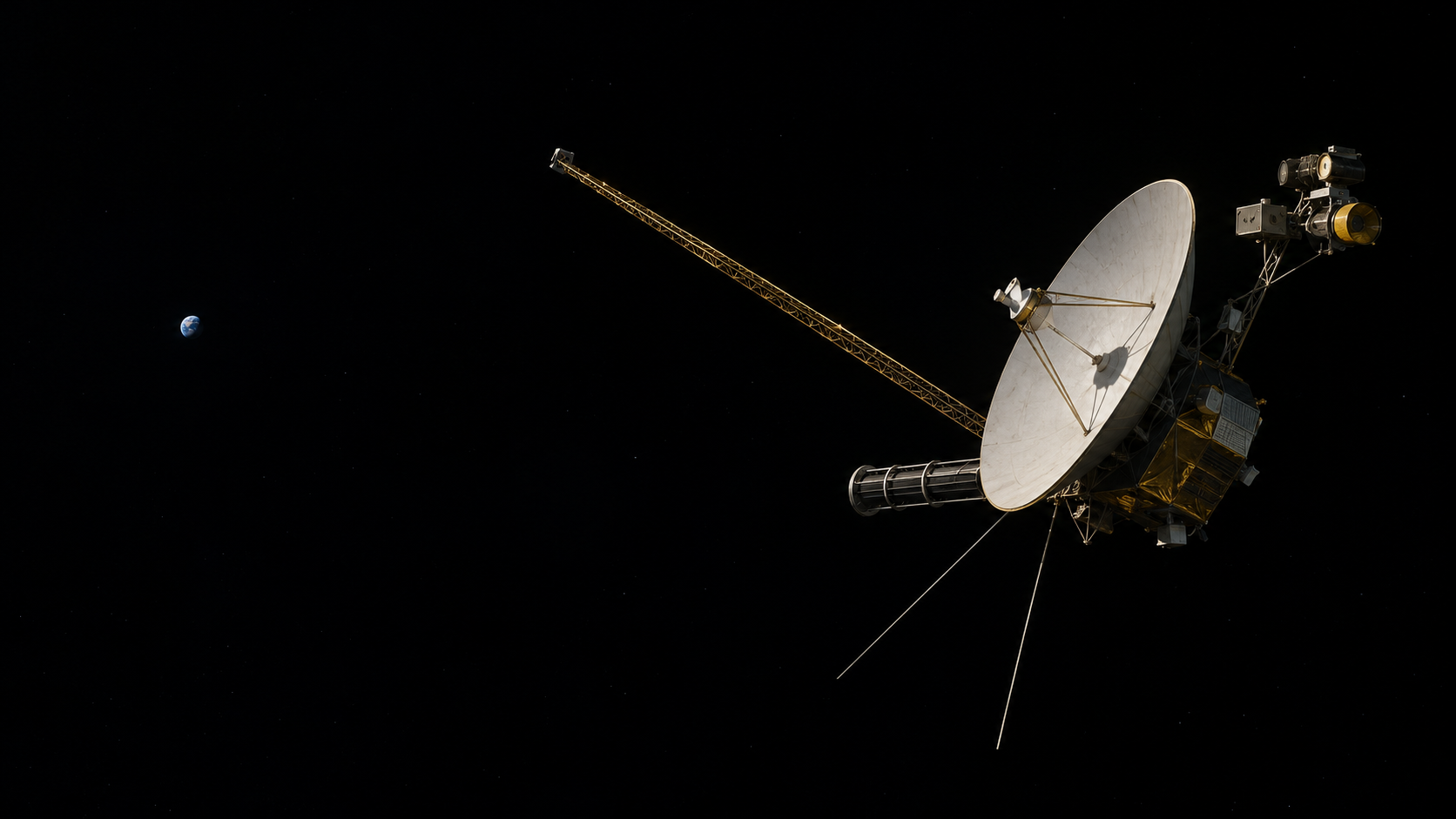
Voyager 1 has spent nearly five decades traveling away from the Sun. Launched in 1977, it explored Jupiter and Saturn, crossed the heliopause, and became the first human-made object to enter interstellar space.
Today, Voyager 1 is roughly one light-day from Earth. This describes distance, not travel time: a light-day is how far light travels in 24 hours, approximately 25.9 billion kilometers (16.1 billion miles).
A radio signal takes about one day to reach Voyager 1, and a reply takes about another day to return. Mission controllers therefore cannot operate the spacecraft in real time.
What Does “One Light-Day From Earth” Mean?
A light-day is a distance, not a duration. Light travels at approximately 299,792 kilometers per second and covers about 25.9 billion kilometers in 24 hours.
When Voyager 1 is described as being one light-day from Earth, the comparison refers to radio communication. A typical command sequence involves these steps:
- Engineers transmit a command.
- The command travels to Voyager 1 for about one day.
- The spacecraft receives and executes the instruction.
- Voyager 1 sends telemetry back to Earth.
- The return signal takes about another day to arrive.
A complete command-and-response cycle can take roughly two days, excluding preparation, scheduling, and analysis. The distance changes continuously because Voyager 1 is moving outward while Earth follows its orbit around the Sun.
One light-day is more than 67,000 times the average Earth–Moon distance. It equals approximately 173 astronomical units (AU), although the exact Earth–spacecraft distance varies. NASA’s Voyager mission page provides updated information.
Voyager 1 Is Not One Light-Year Away
A light-year is the distance light travels in approximately 365 days, or about 9.46 trillion kilometers. One light-year equals roughly 365 light-days.
Voyager 1 is close to one light-day from Earth, not one light-year. Although it has entered interstellar space, it remains extremely close to the Solar System compared with the distances between stars.
Voyager 1’s Journey
Voyager 1 launched from Cape Canaveral on September 5, 1977, aboard a Titan IIIE-Centaur rocket. Voyager 2 launched earlier, on August 20, 1977, but Voyager 1 followed a faster trajectory and reached Jupiter first.
The spacecraft were designed to exploit a rare planetary alignment. Gravity assists from the outer planets changed their speed and trajectories without requiring enormous amounts of fuel. Voyager 1’s original mission focused on Jupiter and Saturn, while Voyager 2 later visited Uranus and Neptune.
Voyager 1 reached Jupiter in March 1979 and Saturn in November 1980. Its close encounter with Saturn’s moon Titan permanently altered its trajectory, sending the spacecraft toward the outer heliosphere rather than another planetary flyby.
Major Discoveries
Jupiter and Io
Voyager 1 revealed Jupiter’s complex weather, faint ring system, powerful storms, and rapidly changing atmosphere. Its most dramatic discovery was active volcanism on Io, the first confirmed evidence of active volcanoes beyond Earth.
Io’s volcanic activity is driven largely by tidal heating. Jupiter’s gravity and interactions among the Galilean moons flex Io’s interior, generating heat. The discovery showed that small moons can remain geologically active. NASA: Io
Saturn and Titan
At Saturn, Voyager 1 studied the planet’s atmosphere, rings, magnetic environment, and moons. It revealed intricate ring structures, gaps, and narrow bands shaped by gravitational interactions.
The spacecraft also performed a close flyby of Titan. Its thick, hazy atmosphere obscured the surface, but instruments confirmed a nitrogen-rich atmosphere with complex chemistry. Later missions, including Cassini-Huygens, found lakes, rivers, dunes, weather, and organic chemistry on Titan.
Entering Interstellar Space
Voyager 1 crossed the heliopause in August 2012. NASA announced the result in 2013 after scientists analyzed the data. The heliopause is the dynamic boundary where the solar wind meets the surrounding interstellar medium. NASA: Voyager 1 Enters Interstellar Space
The crossing was identified through changes in plasma conditions and energetic-particle measurements. The solar wind weakened, while characteristics associated with interstellar space became more prominent.
The heliopause is not a solid wall, and entering interstellar space does not mean Voyager 1 has escaped every form of the Sun’s gravitational influence. It has left the heliosphere, but it has not reached another star system.
Voyager 1’s remaining instruments measure plasma, magnetic fields, energetic particles, cosmic rays, and the local interstellar environment. Its scientific value now comes mainly from particle and field measurements rather than photography.
Communicating With Earth
NASA communicates with Voyager 1 through the Deep Space Network, whose major complexes are near Goldstone, California; Madrid, Spain; and Canberra, Australia. Their geographic separation allows contact as Earth rotates. NASA Deep Space Network
Voyager 1’s signal is extremely weak after traveling tens of billions of kilometers. Large antennas, sensitive receivers, signal processing, error correction, and precise pointing are all necessary to detect it.
The communication delay also complicates troubleshooting. Engineers must prepare commands in advance, transmit them, wait for the spacecraft to receive them, and then wait for telemetry to return. A fault can require several communication cycles to diagnose and correct.
How a 1970s Spacecraft Still Works
Voyager 1 uses radioisotope thermoelectric generators (RTGs), which produce electricity from heat released by the radioactive decay of plutonium-238. Their output declines gradually as the material decays and the thermoelectric components age. NASA: Voyager Power
Mission controllers conserve power by shutting down heaters, instruments, and other systems. They prioritize communication, command processing, attitude control, and the most valuable scientific observations.
The spacecraft also faces aging electronics, limited memory, long communication delays, and increasingly difficult fault recovery. Redundant systems and conservative operating procedures have helped it survive.
In 2024, NASA reported that engineers restored usable science data after a computer-memory problem caused Voyager 1 to transmit unintelligible information. They identified the affected code and data and relocated them within the spacecraft’s memory. NASA: Voyager 1 Resumes Sending Science Data
Why Voyager 1 Still Matters
Voyager 1 provides direct measurements from a region that Earth-based telescopes cannot sample. Decades of observations reveal changes in the interaction between the Sun and the interstellar medium.
The mission is also an engineering case study in redundancy, low-power operation, autonomous safeguards, long-term documentation, and flexible planning. Future missions to the outer Solar System can apply these lessons.
Voyager 1 carries a Golden Record containing sounds, images, music, greetings, and information about Earth. It was created as a symbolic cultural message, not as a practical communication system for a known recipient. NASA: The Golden Record
What Happens Next?
Voyager 1’s power supply will continue to decline. NASA will gradually shut down additional instruments, heaters, or other systems to preserve communication and basic spacecraft operation. The exact timeline depends on power availability, temperature, spacecraft performance, and technical decisions.
Eventually, Voyager 1 will be unable to generate enough electricity, maintain its systems, or transmit a detectable signal. Scientific operations and communication will end before the spacecraft stops moving. It will continue traveling through interstellar space and orbiting the Milky Way with the Sun.
Voyager 1 is not traveling toward a nearby star as a targeted mission. The distances between stars are measured in light-years, so it is not expected to reach another star system on a human timescale.
Common Misconceptions
- “Voyager 1 has completely left the Solar System.” It crossed the heliopause and entered interstellar space, but the broader gravitational Solar System extends much farther.
- “Voyager 1 travels at light speed.” The one-light-day comparison describes distance, not velocity.
- “NASA controls Voyager 1 in real time.” Commands and telemetry require approximately one day each way.
- “Voyager 1 will reach another star soon.” It is only about one light-day from Earth, while stellar distances are measured in light-years.
Conclusion
Voyager 1 is approximately one light-day from Earth, although its exact distance changes continuously. A signal takes about one day to reach the spacecraft, and a reply takes about another day to return.
Since its 1977 launch, Voyager 1 has explored Jupiter and Saturn, discovered active volcanoes on Io, studied Titan, crossed the heliopause, and measured the interstellar environment. Its power and hardware impose strict limits, but the spacecraft continues to demonstrate the durability of carefully designed technology.
Eventually, Voyager 1 will stop sending telemetry. It will nevertheless continue its journey through interstellar space, carrying a record of humanity into the galaxy.
FAQ
How far away is Voyager 1 from Earth?
Voyager 1 is roughly one light-day from Earth: approximately 25.9 billion kilometers or 16.1 billion miles. The exact distance changes continuously. Its distance is also more than 160 AU.
Is Voyager 1 really one light-day away?
Approximately. “One light-day” is a rounded description of its current distance, not a permanent milestone. It means that radio signals take about one day to travel between Earth and the spacecraft.
How long does communication take?
A one-way signal takes approximately one day. A command-and-response exchange takes roughly two days, plus time for preparation, scheduling, execution, and telemetry analysis.
Is Voyager 1 still working?
Yes. Voyager 1 operates in a limited capacity, and NASA continues shutting down systems as available power declines. Check the latest JPL mission status for current details.
Has Voyager 1 left the Solar System?
Voyager 1 crossed the heliopause in 2012 and entered interstellar space. It has not necessarily escaped the Sun’s gravitational influence under the broadest definition of the Solar System.
What happens after communication ends?
Voyager 1 will continue traveling through interstellar space after it can no longer transmit usable telemetry. Its scientific mission will end before its physical motion does.
Related Articles
-
 Teen’s AI Flags 1.5 Million Variable Objects in NASA Archive
-
 SpaceX Dragon Cargo Capsule Returns From the ISS
-
 Ancient African Rift May Be Reawakening
-
 Drone Warns California Fisherman of Reported Great White
-
 Voyager 1 Is About One Light-Day From Earth
-
 Giant Moon and Mars Landscapes Debut in Texas
-
 Can Potatoes Grow in Simulated Lunar Soil?
-
 Triple-Star System 28 Light-Years Away: What We Know
-
 BepiColombo Mercury Arrival: What the Date Means
-
 Webb and the Mystery of a Giant Star Engulfing Its Companion
-
 2026 QQ8: Earth's Possible Mini-Moon Explained
-
 Supermoon Could Worsen King Tide Flooding Before Thanksgiving
-
 AI Exoplanet Searches: What Amateur Astronomers Can Really Find
-
 Perseverance and Odyssey Pause Mars Science Operations
-
 Two New Armored Tardigrades Found on Atlantic Seamount
-
 BepiColombo’s Eight-Year Journey to Mercury Orbit